

Inside eternal.ag: Renji on Building Fully Autonomous Tomato Harvesting Robots for Europe's Greenhouses
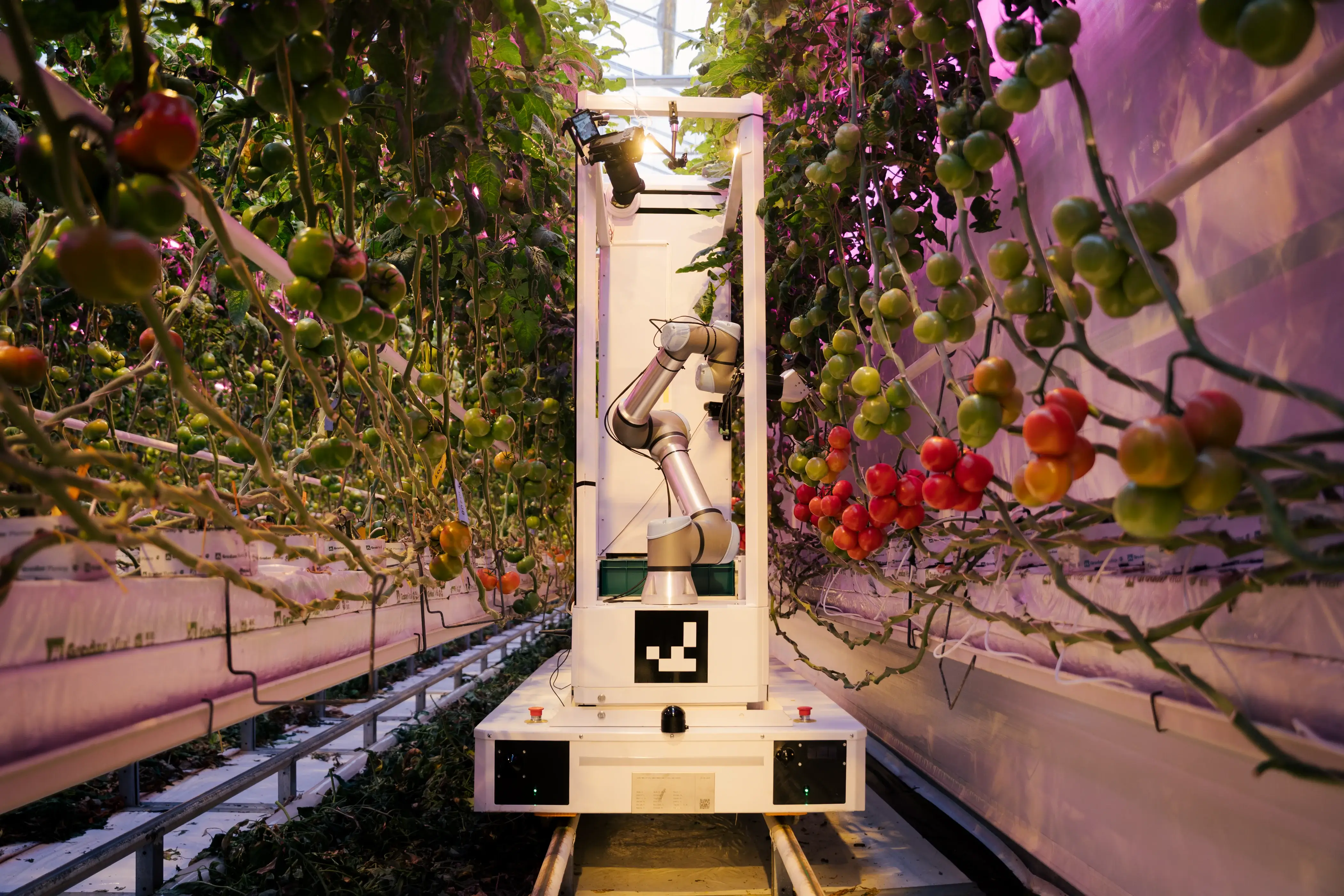
Most founders in 2025 chased software. Renji and Sherry built a robot.

eternal.ag was founded that year on a thesis that European greenhouses are facing a structural labor crisis software cannot fix. European greenhouse labor has declined 30% since 2010. Migration policies are tightening. The workforce is aging. Less demanding jobs are paying better. The math, for a grower trying to harvest tomatoes year-round, simply does not work anymore.

The company's answer is Harvester — a fully autonomous tomato picking robot that, unlike every other harvesting robot on the market, does not require a human operator. The distinction matters more than it sounds. Renji estimates the hidden cost of human-operated robots at over €1 million per 10 hectares over seven years, and that number is what kills most grower business cases before they begin.

eternal.ag has raised €8 million from four institutional investors including Oyster Bay and Simon Capital, deployed first commercial projects in real greenhouses (not demonstration setups), and built a 26-person team split between Cologne and Bengaluru. The development approach is simulation-first: every robot trains in a digital twin of the specific greenhouse it will work in before it touches a real plant.

What follows is the full conversation. We sent thirteen questions. Renji answered all thirteen.

— AgRoboNews.com Editorial
Renji John (CEO & Co-Founder, eternal.ag):
I’ve been working in the horticulture sector for many years and have been driven by the very real and persistent problem of structural labor shortages in Europe and many other places across the world. This is by far the biggest pain point for growers and it puts a consistent and resilient food supply at risk. Greenhouses especially, being indoor and tightly controlled environments, are vital for the food system because yields are produced year-round and are highly resilient to extreme weather, a changing climate and pests.
The world is changing: migration policies are shifting, the workforce is aging and far less demanding jobs are paying staff more, so workers are dwindling in number and it doesn’t look like this is going to change. It was clear to Sherry and I that this labor would only be backstopped with robotics - and robots are reaching a maturity level which makes the timing right for bringing our solution to market. Software-only solutions can support areas like optimization of greenhouse processes, but they are unable to solve this key labor problem as they still need human operators and physical manipulation.
Greenhouses are ideal for developing this solution because they are already highly controlled environments capable of integrating new technologies. AI and computer vision are central to our overall technology as they allow our robots to perceive their environment, act and improve over time.
Renji John (CEO & Co-Founder, eternal.ag):
We’re currently in a phase of developing reliable, commercially viable robots that can master a specific task - in our case, it is tomato harvesting first. Our first customers are already deploying these in real greenhouses and setting the precedent for adoption to continue across the industry.
The next phases will involve building out into other crop types and tasks - for example, cucumber or deleafing - as the technology becomes increasingly capable of taking on more operations. We see these developments being made in the next few years.
At eternal.ag today, we have already built a robot that can perform one of the hardest tasks - harvesting - for one of the most challenging crops - tomatoes. We have already deployed the first commercial projects and proving that this works in real greenhouse scenarios, not just in demonstration or simulation phases. That gives us a jumping off point to prove that this works at scale and to expand the technology outwards into new crops. We’re putting in place solid foundations.
Renji John (CEO & Co-Founder, eternal.ag):
Labor shortages are hugely detrimental to growers and put the food system at risk. Without enough harvesting workers, ripe crops are left unpicked which results in wastage through food spoiling, which means growers lose revenue and less is fed into the food system. Operationally, greenhouses ultimately can’t function effectively without labor.
For staff who are able to work, an already strenuous job becomes even more challenging as they take on more workload, which can result in burnout and even more people turning away from the industry.
With Harvester taking over these responsibilities and working side-by-side with the available labor, yields are consistently higher and better quality, and daily output is stable regardless of labor availability. Harvesting becomes predictable and plannable, with no reliance on seasonal peaks and troughs in labor.
Renji John (CEO & Co-Founder, eternal.ag):
Initially, despite labor shortages crippling the industry, growers are concerned about the economic viability of replacing workers with expensive robots. However, the tipping point that wins their agreement is our approach of full autonomy for robots. Until now, every company in the industry has been focused on building robots that need human operators. This reliance on human operators translates into a hidden cost of over €1 million over seven years for the grower per 10 ha. This is a deal breaker for most growers as the unit economics do not make sense. By providing fully autonomous robots that do the crop work without human operators and by aligning to an outcome-based business model, eternal.ag is fully aligned with the success of the robots. Eternal.ag succeeds only when the grower succeeds and that is a very strong incentive for the grower to work with us.
Renji John (CEO & Co-Founder, eternal.ag):
A simple way to frame it is to say that we train our robots by practicing in a like-for-like digital environment that we’ve designed to mirror their greenhouse. It’s like pilots practicing on a flight simulator before getting into the cockpit of a real plane.
This matters because it helps us to deploy a reliable robot faster as it’s already failed and learned from trial and error in the simulated environment. This means less risk of errors, and it means quicker adaptation to each specific greenhouse environment. The majority of any potential mistakes have already been made and learned from without real-world consequences, and investment returns will be quicker with less downtime and faster deployments.
Renji John (CEO & Co-Founder, eternal.ag):
We will be expanding the technology to additional crop genotypes so that our proven Harvester solution can be deployed to even more greenhouses and support growers specialized in other crops.
We will also use the capital to convert our prospective customer pipeline into active projects and scale the number of robots deployed to customers.
The funding will also help us to deliver on our expansion plans. We want to deepen our existing footprint in the Benelux and DACH regions, but also support growers Europe-wide and take initial steps towards the North American market. Labor shortages are being felt globally so there is a commercial case for this kind of international growth.
Finally, we will continue building our already strong team of experts across Europe and India in all areas of the business: robotics, AI, support and business operations.
Renji John (CEO & Co-Founder, eternal.ag):
We largely speak directly to growers. Many greenhouses are long-standing businesses with established ways of working, so it’s important that growers learn about our offering directly from us. Our team brings a wealth of experience in the horticulture industry and, as such, we have developed an intricate understanding of what growers need, what their challenges are and how robotics can transform their operations. That makes direct-to-customer sales the best approach for us at this stage.
Renji John (CEO & Co-Founder, eternal.ag):
We are in the midst of setting up service partnerships for our customers to-be in North America. For robotics to scale within the greenhouse environment for crop work, it is fundamentally necessary to have the right servicing and maintenance processes in place so that growers can have the peace of mind that if anything does go wrong, it will be tackled immediately.
Renji John (CEO & Co-Founder, eternal.ag):
We are in the very fortunate position that we do not have engineering problems that need to be solved further. At this moment we are looking at scaling our manufacturing processes with a series production partner, which we will announce later. After tomatoes, we expect that we will go into other high-wire crop types. We have also not ruled out the berries segment either because of the huge labour problems that exist there.
Renji John (CEO & Co-Founder, eternal.ag):
We are already building next generation physical AI for greenhouses and hope to share more with the industry at the appropriate time. Given the advancements that are happening in the hardware and artificial intelligence space, the time is now to seize opportunities to uplift the horticultural sector as a whole. This will happen not just with physical AI and robotics but also with other companies who are working in the space on very critical areas such as climate control, irrigation and so on. We believe that collaboration between companies and various industry partners is what got the horticulture sector to where it is right now and we look forward to partnering with companies to take it to the next level in the future.
Renji John (CEO & Co-Founder, eternal.ag):
We have been very fortunate to be able to get hundreds of applications daily for the various open roles on our website after we came out of stealth. This just reaffirms that there is a lot of talent out there looking for a company with a real purpose tackling hard problems. We have not had challenges in filling roles and instead look at hiring anyone with the right fit and qualifications into the company. This means that we might have already hired people into the open positions but are still keeping the job postings open in case we can find more people who would be able to join us on our mission.
Renji John (CEO & Co-Founder, eternal.ag):
Commercially, we want to be consistently growing our customer base and scaling the number of robots deployed in greenhouses, as well as demonstrating the strong economic model that we deliver to our growers.
Technically, we want our deployments to be evidence of reliability at scale and in different greenhouses across geographies. We also want to be making strides towards proving the technology’s effectiveness for other crop types.
Our ideal investor shares our deep passion for robotics and Physical AI and an appreciation for the fundamental problem we’re solving – food security.
Renji John (CEO & Co-Founder, eternal.ag):
I would love to see publications showcasing more case study success stories which serve as proof points for the deployment of new innovations like ours. It would also be valuable to see more reporting on the economic viability of incorporating robots to give potential customers confidence in taking the leap.